Do you ever feel like you’re running a marathon that has no finish line? You wake up, check your email before your feet even hit the floor, and spend the rest of your day putting out fires until you collapse back into bed. If you’re nodding your head, you’ve probably fallen into the “hustle trap.”
We’ve all been there. In the early days of starting a business, “hustle” is the fuel. But here’s the cold, hard truth: hustle doesn’t scale. If your business only moves when you’re pushing it with 110% of your effort, you don’t have a business, you have a very demanding, very exhausting job.
Well, here’s some good news for you: there’s a better way. The most successful solopreneurs aren’t the ones working the most hours; they’re the ones with the best systems. By shifting your focus from hustling harder to building better processes, you can reclaim your time, your sanity, and actually enjoy the business you’ve worked so hard to build.
Ready to stop the burnout cycle? Let’s dive into the five essential processes you need to put your business on autopilot (or at least on a much smoother track).
TL;DR: The Burnout-Proof Blueprint
- The CEO Schedule: Stop reacting and start blocking your time for deep work and rest.
- The Client Gates: Use onboarding checklists and clear boundaries to stop “scope creep” before it starts.
- The Marketing Drumbeat: Choose one primary channel and create a repeatable weekly rhythm.
- The Digital Assistant: Automate the “boring stuff” like invoicing and scheduling to save hours every week.
- The Support Squad: Don’t go it alone. Join a community to share the load and gain fresh perspectives.
1. The CEO Schedule: Managing Your Energy, Not Just Your Time
Have you ever reached the end of a 10-hour workday and wondered, “What did I actually accomplish today?”
When you’re a solopreneur, your energy is your most valuable asset. If you spend it all on micro-decisions, like what to post on social media or which email to answer first, you won’t have anything left for the big-picture “CEO work” that actually grows your business.
How to build this system:
- The Weekly Rhythm: Instead of a giant to-do list, use “theme days.” For example, Mondays for marketing and strategy, Tuesdays through Thursdays for client work, and Fridays for admin and “closing the books.”
- Time Blocking: Use a calendar tool to block out “Deep Work” sessions. During these times, your phone is away, and your notifications are off.
- The “Non-Negotiable” Rest: You wouldn’t let your phone battery hit 0%, so why do it to yourself? Schedule at least one full day off per week where you don’t even look at your business.

By documenting these “rules” for yourself, you stop wasting mental energy on when to work and start focusing on the work itself. You can find more tips on structuring your day in our Bright Ideas section.
2. The Client Gates: Onboarding and Boundaries
Let’s be honest: some of the biggest contributors to burnout are the clients we love… but who don’t respect our time. You know the ones, the “quick question” at 9:00 PM on a Saturday or the request for “just one more tiny change” that turns into five hours of work.
The solution isn’t to work with fewer people; it’s to build better gates.
How to build this system:
- The Standardized Onboarding: Create a “Welcome Packet” (it can be a simple PDF or a dedicated page on your site). This should outline how you work, when you’re available, and what the client can expect from you.
- The Intake Form: Don’t waste time on back-and-forth emails. Use a form to gather all the info you need before a project starts.
- The Communication Rule: Tell your clients exactly how to reach you. If you prefer email, tell them you don’t check DMs for business. It feels scary at first, but clients actually appreciate the clarity!
When you have a repeatable onboarding process, you aren’t reinventing the wheel every time a new lead comes in. You’re just opening the gate and letting them into a system that’s already built for success.
3. The Marketing Drumbeat: Consistency Over Intensity
Are you “panic posting” on social media only when you realize you haven’t had a new lead in two weeks? That’s a recipe for stress.
You don’t need to be on every platform. In fact, trying to be everywhere is the fastest way to get nowhere. Instead, you need a “marketing drumbeat”, a steady, predictable rhythm that keeps you top-of-mind without requiring 20 hours a week.
How to build this system:
- Pick Your “One”: Choose one primary platform where your target audience hangs out. Maybe it’s LinkedIn, maybe it’s a weekly newsletter, or maybe it’s attending local networking events.
- The Batching Method: Spend two hours on your “Marketing Monday” creating all your content for the week.
- The Lead Tracker: Keep a simple spreadsheet (or use a CRM) to track who you’ve talked to and who needs a follow-up.
Remember, marketing isn’t about the biggest splash; it’s about the consistent ripple. If you need help refining your message, our marketing consulting services are designed specifically for small teams like yours.
4. The Digital Assistant: Automate the Boring Stuff
If you are still manually typing out invoices, sending “What time works for you?” emails, or chasing down payments, you are leaving money on the table. Why? Because your time is worth more than the $20–$50 a month a good automation tool costs.
How to build this system:
- The Scheduler: Use a tool like Calendly or Acuity. Send a link, let them pick a time, and let the tool handle the calendar invites and reminders.
- The Automated Invoice: Set your accounting software to send recurring invoices and, this is the best part, automatic late payment reminders. No more awkward “Where’s my money?” emails.
- The Canned Response: Do you find yourself answering the same three questions over and over? Save those answers as templates in your email provider. One click and you’re done!
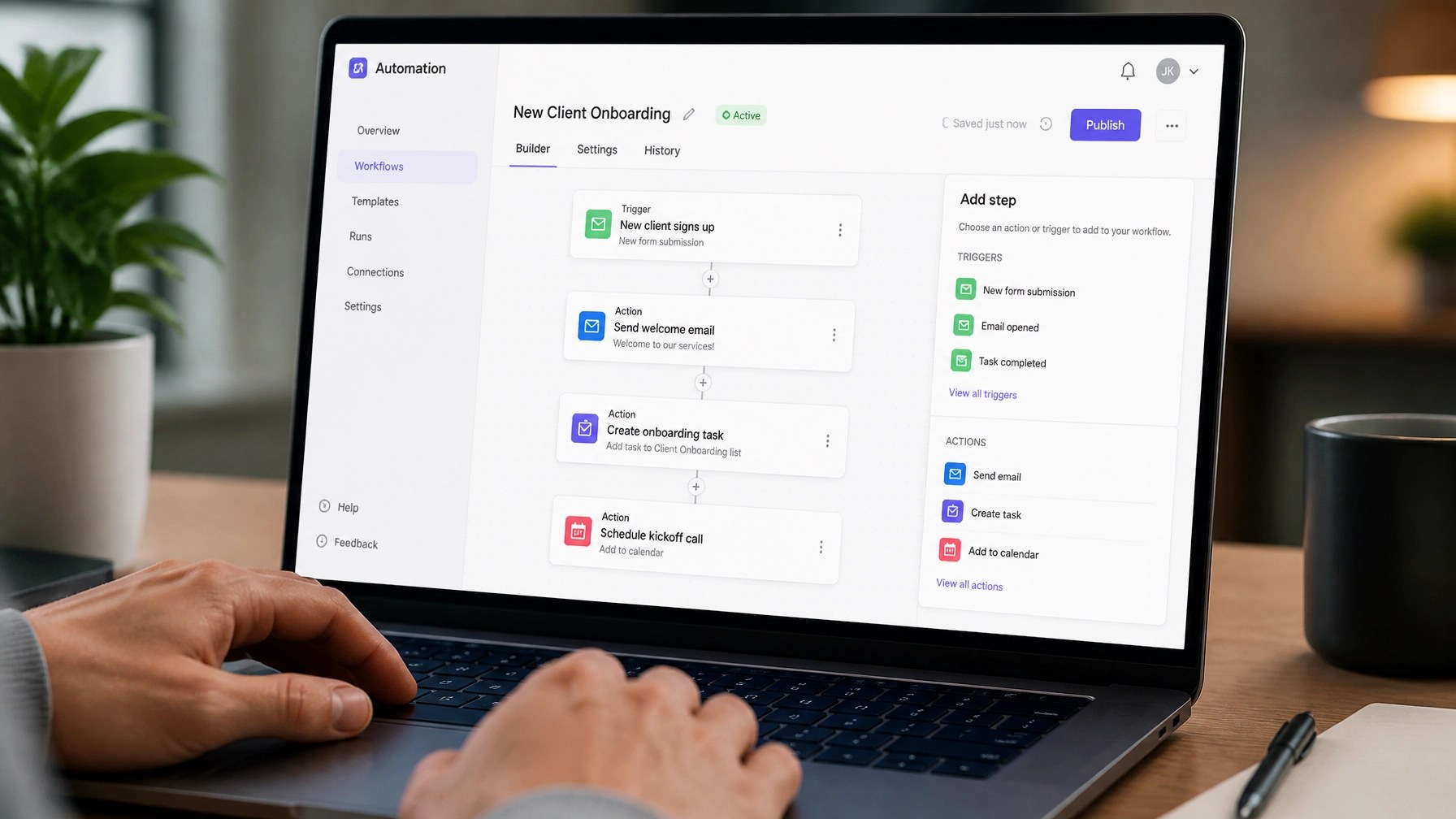
Also, keep in mind that smart technology services can help you bridge the gap between “I’m doing this all by hand” and “My business runs while I sleep.”
5. The Support Squad: Building Your Community
The loneliest part of being a solopreneur is feeling like you’re the only one facing these challenges. But here’s a secret: every entrepreneur you admire has felt exactly the same way.
Burnout often happens in a vacuum. When you don’t have anyone to bounce ideas off of or vent to after a tough day, the weight of the business stays entirely on your shoulders.
How to build this system:
- Join a Mastermind or Group: Surround yourself with people who are at your level or one step ahead. They can offer shortcuts you haven’t thought of.
- The Referral Network: Build relationships with other B2B professionals, accountants, marketers, attorneys. Not only can they send you business, but they can also be your “back office” of experts.
- Show Up Regularly: Don’t just go to one event and disappear. Consistency in networking builds the “Know, Like, and Trust” factor that leads to long-term growth.

At INSPIREsmall.biz, we believe that community is the ultimate system. Our networking groups are designed to provide that support so you never have to “hustle” in isolation.
Your Next Steps to Systemize
And, always remember: you don’t have to build all five of these systems today. Trying to overhaul your entire business at once is… well, it’s just another way to burn out!
Start with one. Maybe this week you just set up an automated scheduler. Next week, maybe you write down your onboarding checklist. Small, steady improvements are what lead to a sustainable, profitable business.
Want to get started? Here’s your 3-step action plan:
- Identify your biggest leak: Where are you wasting the most time or feeling the most stress? Start your first system there.
- Audit your tech: Are you using tools that make your life easier, or are you fighting with them? Check out our web hosting and tech resources for better options.
- Find your people: Come to our next INSPIREsmall.biz event and meet other owners who are moving from hustle to systems.
You’ve got the vision. Now, let’s build the systems to support it. You’ve got this!